


24/09/2019

Sourceforge: Clover UniBeast, and MultiBeast without access to a Mac.


elcap-ub.png
The following guide is a complete walkthrough for updating to or installing a fresh version of OS X El Capitan. It requires no experience and all of the basic installation and post-installation tools are available on tonymacx86.com.

Table of Contents
Step 1: Download OS X El Capitan
Step 2: Create a Bootable USB with UniBeast
Step 3: Recommended BIOS Settings
Step 4: Install OS X El Capitan
mb_circle-sm.png Step 5: Post Installation with MultiBeast
clover-circle-sm.png Step 6: Alternate Post Installation
Troubleshooting and Optimizations


Before You Begin

1. Register here at tonymacx86! If you don't have a user account, create one!
2. Get our latest UniBeast and MultiBeast tools from the downloads section.
3. Purchase a 16GB or larger USB drive.
4. Do a full backup of your system. We strongly recommend performing a full backup of your existing system using Carbon Copy Cloner. By doing this, you can always go back to your working installation.

UniBeast is a tool that creates a bootable installer out of your downloaded version of OS X. In order to start fresh, you'll need access to a functional computer running Mac OS X Snow Leopard 10.6.8 or later. This is a requirement, as you need access to the Mac App Store to download OS X and create the installation drive. To start from scratch, booting the 10.6 Snow Leopard Retail DVD directly, check out iBoot + MultiBeast.

For the first time tonymacx86.com is recommending Clover as your default bootloader. If you have followed updates until OS X Yosemite using Chimera, check out Clover Basics and Switching Advice.

Existing Clover users may do a direct update to OS X El Capitan by simply running the Install OS X El Capitan app as normal Mac users would. Follow these steps: Direct Update to OS X El Capitan using Clover.


STEP 1: Download OS X El Capitan
The full operating system is a free download for anyone who has purchased Mac OS X Snow Leopard, Lion, or Mountain Lion or has a Mac preloaded with OS X Mavericks or Yosemite. Download the Application from the Mac App Store using your Apple ID on any Mac or functional computer running Mac OS X 10.6.8 or later.

1. Open Mac App Store
2. Log in with your Apple ID
3. Download OS X El Capitan

The Application Install OS X El Capitan will appear in /Applications.
buyElCap.png


STEP 2: Create a Bootable USB Drive with UniBeast
Take a deep breath and take your time- this is pretty simple, but it's easy to miss things if you rush. Follow each step to the letter.

1. Insert the USB drive
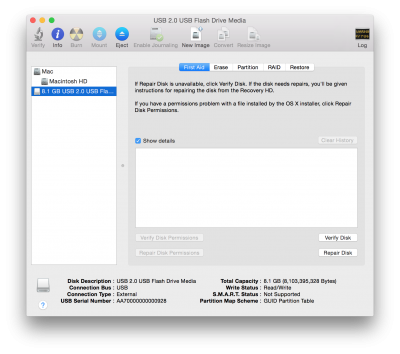
2. Open /Applications/Utilities/Disk Utility
3. Highlight the USB drive in left column
createUSB.png
diskutil-1.png
4. Click on the Partition tab
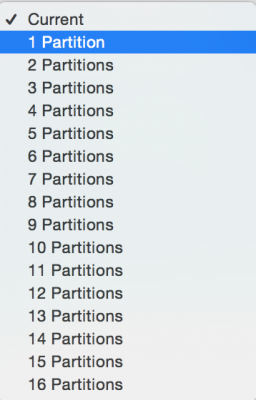
5. Click Current and choose 1 Partition
diskutil-2.png
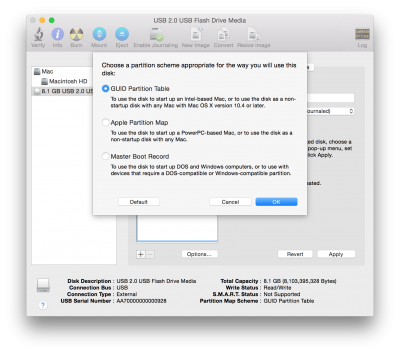
6. Click Options...
7. Choose GUID Partition Table
diskutil-3.png
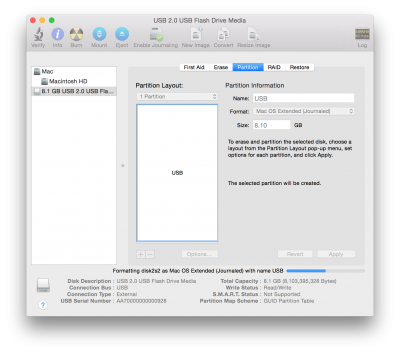
8. Under Name: type USB (You can rename it later)
9. Under Format: choose Mac OS Extended (Journaled)
10. Click Apply then Partition
diskutil-4.png
11. Download and run UniBeast
12. Click Continue, Continue, Continue, Continue, Agree
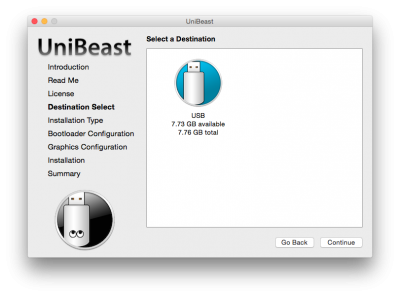
13. At Destination Select, choose USB and click Continue
ub1.png
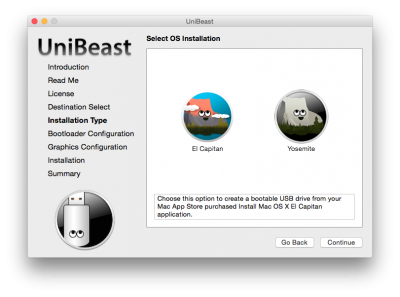
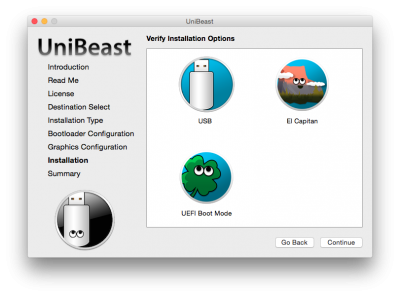
14. At Select OS Installation screen choose El Capitan and click Continue
ub2.png
15. At Bootloader Options screen choose UEFI Boot Mode or Legacy Boot Mode. UEFI Boot Mode is recommended for 7/8/9+ Series CustoMac desktops and all UEFI capable systems. Legacy Boot Mode is recommended for 5/6 Series CustoMac desktops and all BIOS based systems.
ub3.png
16. (Optional) At Graphics Configuration screen choose the appropriate graphics option for your system and click Continue.
17. Verify installation options, then click Continue, enter password and click Install
ub5.png
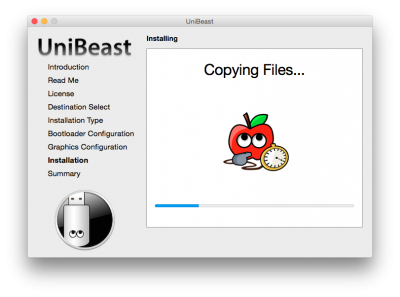
UniBeast will now create the bootable USB drive. The process will only take about 10 minutes, depending on system and drive speed. Do not unplug or stop during this time.
ub6.png
18. Drag MultiBeast to your completed USB drive.

Clover Note: UniBeast delivers basic bootloader support based on our testing on recommended CustoMac systems. For further bootloader customization, download and run the official Clover package. Advanced users may also compile Clover by downloading the full source.


STEP 3: Recommended BIOS Settings
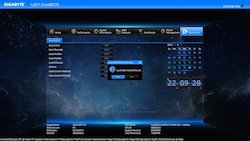
If you're installing on a recommended CustoMac desktop with AMI UEFI BIOS, the options are simple. For other systems make sure to set your BIOS to Optimized Defaults, and your hard drive to AHCI mode. Here are standard AMI UEFI BIOS settings for Gigabyte AMI UEFI BIOS, Gigabyte AWARD BIOS, ASUS AMI UEFI BIOS, and MSI AMI UEFI BIOS.

1. To access BIOS/UEFI Setup, press and hold Delete on a USB Keyboard while the system is booting up
2. Load Optimized Defaults
3. If your CPU supports VT-d, disable it
4. If your system has CFG-Lock, disable it
5. If your system has Secure Boot Mode, disable it
6. Set OS Type to Other OS
7. If your system has IO SerialPort, disable it
8. Set XHCI Handoff to Enabled
9. If you have a 6 series or x58 system with AWARD BIOS, disable USB 3.0
10. Save and exit.
gigabyte-z87x-ud7-th-1.jpeg

STEP 4: Install OS X El Capitan
You're almost done! All you need to do is boot from the USB drive and install! For best results, insert the USB in a USB 2.0 port.

1. Turn on the computer
2. Press the hotkey to choose boot device (usually F12, F11, F10, or F:cool:
3. Choose USB
4. At Clover boot screen, choose Boot Mac OS X from USB
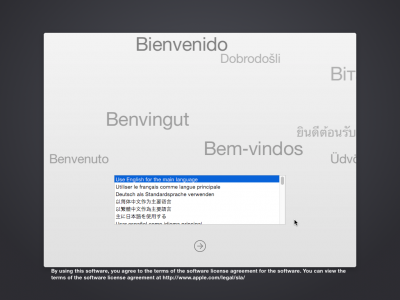
5. When you arrive at the Installer, choose language.
installElCap.png
If you have issues reaching the installer, first make sure you're using a USB 2.0 port. If you're using a NVIDIA graphics card you may need to enter the extra boot flag nv_disable=1 to reach the installer. For instructions on entering boot flags see Clover Basics and Switching Advice.
Snapshot 9.png
6. For a new installation of OS X, you MUST erase and format the destination drive according to the following steps before continuing.
a. In the top menu bar choose Utilities, and open Disk Utility
b. Highlight your target drive for the El Capitan installation in left column.
c. Click Erase button
d. For Name: type El Capitan (You can rename it later)
e. For Format: choose OS X Extended (Journaled)
f. For Scheme: choose GUID Partition Map
g. Click Erase
h. Close Disk Utility
7. When the installer asks you where to install, choose El Capitan, or your existing install.
8. Upon completion, the system will automatically restart.


STEP 5: Post Installation with MultiBeast
MultiBeast is an all-in-one post-installation tool designed to enable boot from hard drive, and install support for Audio, Network, and Graphics. The installation is complete, but the drive isn't bootable yet. Boot from the USB again, this time choosing El Capitan.

1. Turn on the computer
2. Press the hotkey to choose boot device
3. Choose USB
4. At the Boot Screen, choose your new El Capitan installation.
5. Complete OS X El Capitan setup
mb_circle.png
6. Open and run MultiBeast. If your system requires installing Clover to the root of the drive, such as Gigabyte 6 Series and X58 systems, skip to STEP 6.
multibeast-1.png
7. If this is a fresh installation, click Quick Start. UEFI Boot Mode is recommended for 7/8/9+ Series CustoMac desktops and all UEFI capable systems. Legacy Boot Mode is recommended for 5/6 Series CustoMac desktops and all BIOS based systems.
multibeast-2.png
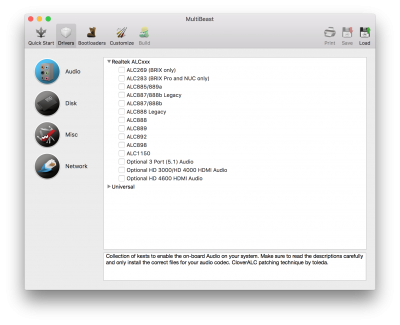
8. Choose the appropriate audio and network options for your system:
MultiBeast-3.png
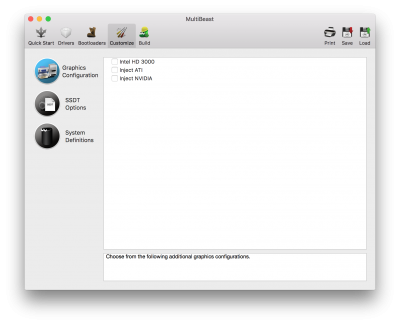
9. Click Customize for further options
multibeast-4.png
10. Click Print or Save to back up your configuration
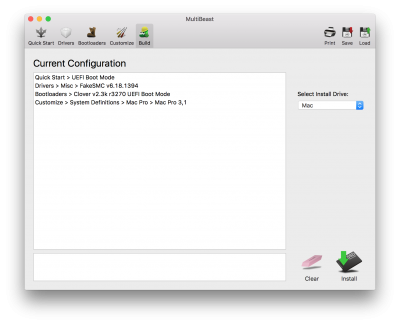
11. Click Build then Install
multibeast-5.png
If using a NVIDIA 'Maxwell' GeForce GTX 750, 750 Ti, 950, 960, 970, 980, 980 Ti, or TITAN X graphics card, OS X graphics drivers are not natively supported. Alternate NVIDIA drivers are required. If drivers do not initiate, add nvda_drv=1 to Clover config.plist under Boot > Arguments.

12. (Optional) Download and install Alternate NVIDIA Graphics Drivers
13. Reboot

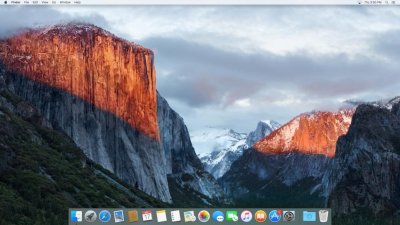
elcap-desktop.jpg

Yay! You now have a fully updated bootable version of OS X El Capitan on your CustoMac! And a super handy USB rescue drive. It's easy to get frustrated, but don't give up! If you get stuck, there are many users with similar hardware in the tonymacx86 Forum to provide support.

Thanks to all of the hard working developers, hackers, and testers all over the world without whom this guide would never have been possible.


STEP 6: Alternate Post-Installation
This alternate post-installation method was in place before MultiBeast was released. If you have already used MultiBeast you do not need to follow these steps. Follow this method if your system requires installing Clover to the root of the drive.

1. Press the hotkey to choose boot device
2. Choose USB
3. At Clover boot screen, choose Boot Mac OS X from El Capitan
4. Complete OS X El Capitan setup
5. Download El Capitan Post-Install Tools
clover-circle-medium.png
The Post-Installation.zip contains two custom Clover installers and essential kexts. This will provide boot from hard drive in place of MultiBeast. Alternately, continue booting from the USB drive.

6. Run one of the custom Clover installers. UEFI Boot Mode (Clover_v2.3k_r3320_UEFI.pkg) is recommended for 7/8/9+ Series CustoMac desktops and all UEFI capable systems. Legacy Boot Mode (Clover_v2.3k_r3320_Legacy.pkg) is recommended for 5/6 Series CustoMac desktops and all BIOS based systems. Legacy Boot Mode - Root (Clover_v2.3k_r3320_Legacy_Root.pkg) is for older systems that cannot boot from EFI partition. For further bootloader customization, download and run the official Clover package. For further bootloader customization, download and run the official Clover package.
7. Run CustoMac Essentials to install FakeSMC and Ethernet support.

The next steps configure the system definition, configure graphics, and provide it with a unique serial number.

8. Download and open Clover Configurator
9. Your config.plist should auto-mount. If not, choose Mount EFI Partition.
10. Select SMBIOS tab
11. Press Magic Wand Icon
12. Choose a System Definition from the list. Then choose a version of the system from the dropdown. This will auto-populate your config.plist with appropriate SMBIOS information including a unique serial number. If you're unsure what to choose, Mac Pro 3,1 will work for most desktop systems.
13. (Optional) If you have an existing Chimera SMBIOS located at /Extra/smbios.plist, you can choose the same system definition in Clover Configurator, then copy that serial number into your config.plist manually.
14. (Optional) If you configured graphics for the UniBeast installation, open Graphics tab and select Inject NVIDIA or Inject ATI.
15. Save and close Clover Configurator.

The next optional steps configure the system's Realtek ALC onboard audio codec.

16. (Optional) Download CloverALC110 script
17. (Optional) Browser/Click on download file
18. (Optional) Finder/Double click .command file
19. (Optional) Go through steps in Terminal to install appropriate audio choices

If using a NVIDIA 'Maxwell' GeForce GTX 750, 750 Ti, 950, 960, 970, 980, 980 Ti, or TITAN X graphics card, OS X graphics drivers are not natively supported. Alternate NVIDIA drivers are required. If drivers do not initiate, add nvda_drv=1 to Clover config.plist under Boot > Arguments.

20. (Optional) Download and install Alternate NVIDIA Graphics Drivers
21. Reboot


Troubleshooting and Optimizations:
After you've completed the guide, things such as HDMI audio and iMessage may not work automatically and universally. The list below should serve to fully optimize your system after initial setup.

Clover Basics and Switching Advice
Big List of Solutions for El Capitan Install Problems
How to Fix iMessage
HDMI Audio
Create a Clover Test USB Using UniBeast
How to Backup and Remove Chimera and any Related Files
How to Enter/Edit Boot Flags in Clover
How to Edit Clover config.plist
How to Mount EFI Partition
How to Set Clover to Automatically Boot System Drive
[GUIDE] Remove extra Clover BIOS boot entries & prevent further problems
OS X Configuration, Tuning & Utility Tools
How To Show Hidden Files in Finder
[Guide] Airport - PCIe Half Mini v2
Continuity and Handoff Capable Apple Mini Cards + PCIe and mini-PCIe Adapters
Direct Update to OS X El Capitan Using Clover
Laptop Compatibility
Quick Guide to Generate a SSDT for CPU Power Management
[READ ME FIRST!] Graphics Setup & Troubleshooting
Solving NVIDIA Driver Install & Loading Problems
CustoMac Desktop USB Fixes - OS X 10.11 El Capitan - Reference
[Guide] 10.11+ USB changes and solutions
DSDT Database | tonymacx86.com
The Basics

Alternate NVIDIA Graphics Drivers
NVIDIA releases alternate graphics drivers separately on the web for each OS X build. These are different from the drivers Apple ships as standard, and should be considered experimental. In the past, the drivers have been known to solve OpenCL issues with certain applications, as well as providing better native GPU power management for certain devices. They also will enable 'Maxwell' cards to work with full acceleration- NVIDIA GeForce GTX 750, 750 Ti, 950, 960, 970, 980, 980 Ti, and TITAN X.

http://www.tonymacx86.com/threads/nvidia-releases-alternate-graphics-drivers-for-os-x-10-11-6-346-03-15.198033/

Clover Bootloader Credits
UniBeast contains and deliver files from the Clover EFI Bootloader project. For more information and sources used see Clover EFI bootloader. Clover v2 is open source based on different projects: Clover, rEFIt, XNU, VirtualBox. The main is EDK2 latest revision.

Clover Note: UniBeast delivers basic bootloader support based on our testing on recommended CustoMac systems. For further bootloader customization, download and run the official Clover package. Advanced users may also compile Clover by downloading the full source.

Clover Developers:
Slice, with help of Kabyl, usr-sse2, jadran, Blackosx, dmazar, STLVNUB, pcj, apianti, JrCs, pene, FrodoKenny, skoczy, ycr.ru, Oscar09, xsmile, SoThOr, rehabman…

Source code credits:
Intel, Apple, Oracle, Chameleon, rEFIt and Xom.

Clover Source and Downloads:
Sourceforge: Clover
 

 installation.png
Here, in the simplest of terms, is the method for retail Mac OS X installation using iBoot, UniBeast, and MultiBeast without access to a Mac. If you have access to a Mac, use the default UniBeast guide on it's own.

1. Purchase Snow Leopard Retail DVD
2. Use iBoot + MultiBeast to install Snow Leopard
3. Update to Snow Leopard 10.6.8
4. Purchase OS X Application
5. Prepare UniBeast USB Installation Drive
6. Fresh install OS X
7. Post installation using MultiBeast

Hope this helps. :thumbup:


iBoot 10.6 Guide http://tonymacx86.blogspot.com/2010/04/ ... -x-on.html
UniBeast 10.7 Guide http://tonymacx86.blogspot.com/2011/10/ ... using.html
UniBeast 10.8 Guide http://www.tonymacx86.com/threads/unibeast-install-os-x-mountain-lion-on-any-supported-intel-based-pc.60584/
UniBeast 10.9 Guide http://www.tonymacx86.com/threads/unibeast-install-os-x-mavericks-on-any-supported-intel-based-pc.112389/
UniBeast 10.10 Guide http://www.tonymacx86.com/threads/unibeast-install-os-x-yosemite-on-any-supported-intel-based-pc.143976/
UniBeast 10.11 Guide http://www.tonymacx86.com/threads/unibeast-install-os-x-el-capitan-any-supported-intel-based-pc.172672/
tonymacx86 Downloads: downloads
Last edited:


Joined
Mar 28, 2012
Messages
29
Mac
Classic Mac
Mobile Phone


Thanks for this MacMan! Of course, this works great (if used correctly). I've use this post to make my Snow Leopard installation work too. This looks like a lot of stuff, but the whole process only takes about 2 hours. 3 if you include putting the parts together to build your system.

Here's how:

* Purchase Snow Leopard upgrade DVD as per instructions above or here: Mac OS X 10.6 Snow Leopard - Apple Store (U.S.)

* Download appropriate DSDT file for motherboard & save to USB Flash drive (I used a 4GB).

* Download iBoot & burn to CD/DVD.

* Download SL 10.6.8 Combo Update from Apple, here: Mac OS X 10.6.8 Update Combo v1.1

& save to USB Flash drive with your DSDT.

* Download Multibeast for Snow Leopard & save to USB Flash drive.

* Build system as per instructions with 1.5TB HDD installed (you'll have to slice it up once you get to the installation).

* Boot with iBoot

* Use Disk Utility to slice 1.5TB drive at 600GB boot partition, named "Snow Leopard HD" & the other 900GB partition named "Extra"

* Install Snow Leopard as per 'regular' instructions.

* When "done" have boot0 error, so remove this HD for now...

* Install another 500GB HDD (could use a drive as small as 20GB as long as it's SATA or Solid State) & install SL exactly the same way on this drive, EXCEPT make only 1 partition as per TonyMacx86's original instructions.

** NOTE ** I suggest that you name the partition something simple, like "Mac HD" & NOT the same thing you named your other boot partition.

* Once THIS drive is built, you will NOT have the boot0 error, unless they change the architecture on the smaller drives too.

* Put leave the smaller (good) drive in the system & put the bigger (not booting) drive in with it. If your drive is 6GB/S drive, you can now move it to the white SATA controller port too.

* Boot the system (to the only drive that works).

* Once your system is up, open Drive Utility. Unmount the the first drive you built with the boot0 error, the "not booting" drive, that's named "Snow Leopard HD".

* Open a Terminal window. I suggest you take a moment to understand what you're going to do next.

First, you will not be able to use MacMan's command unless you can su to root first. Since you probably don't know what that means, you can't use the command.

You need to use "sudo" to make the command work. I suggest you take a couple of minutes to get the info on "sudo", by typing (yup, you guessed it!!) "info sudo" in the terminal window. You can arrow down to go down the page & press "q" to "quit" & get out of info. Using "sudo" is sort of like "assuming the identity of root" from now on.

In the Terminal window once you type 'sudo' & the command, you'll have to enter your password to execute the command. Also, in OSX from there on out YOU ARE root too, so any other commands you type can be dangerous. You only have to type sudo once!! So if you mess up the command that MacMan has graciously given us, you don't have to type 'sudo' again.

* Take a deep breath. Take a shot of Tequila. OK. You're ready...

The drive you booted from is named "Snow Leopard HD". The drive you didn't boot from is named "Mac HD". So, the command is :

sudo dd if=/Volumes/Mac\ HD/usr/standalone/i386/boot1h of=/dev/disk0s2

*** But Wait *** Don't type that command!! Copy it & Paste it!! That away you'll be sure to get it right. YES, Terminal WILL let you copy & paste (of course, one is no good without the other). So, copy this whole post & put it in a Text File & put THAT on your USB Flash drive too.

* OK. That wasn't too bad. If you saw some messages that said you messed up, you need to press the "UP" arrow to bring your last command back & then modify the command. You probably messed up the "Mac\ HD" thing. Make sure to take the "sudo" off the front of the command though.

* If you didn't see a message that said you messed up, then you were successful.

* Shut down your system. Remove the smaller drive & boot up your new Snow Leopard Installation!!!

***** Good Luck ***** Thanks MacMan & Tonymacx86 ***** Consider making a donation to keep this site working

Aucun commentaire:

Enregistrer un commentaire

AUR Archlinux FR

AUR Archlinux FR

ArchwikiFR Accueil Forum Wiki Bugs Paquets AUR Télécharger Planète ...

Derniers évènements :